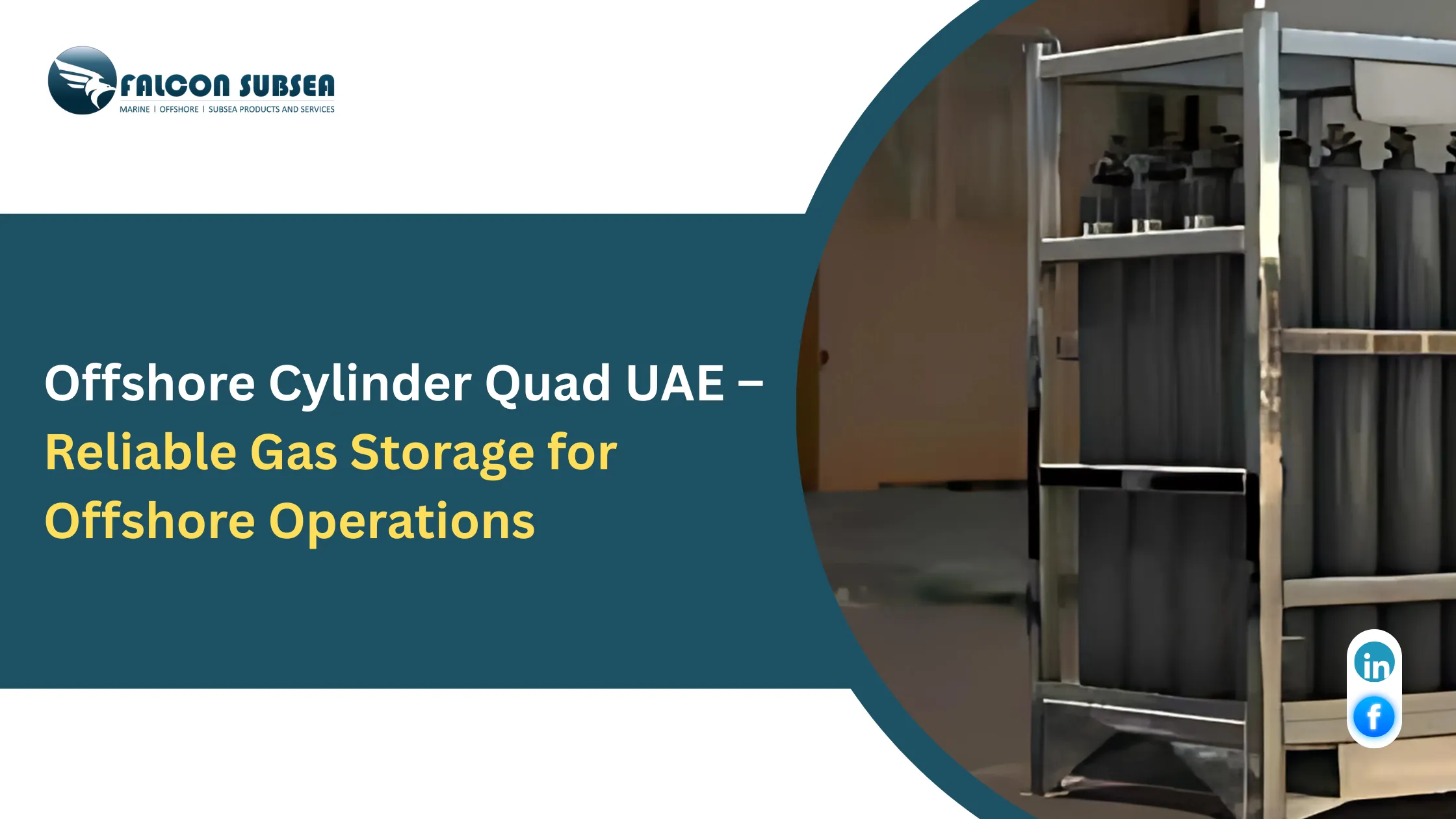
Offshore Cylinder Quad UAE – Reliable Gas Storage for Offshore Operations
Introduction
Offshore cylinder quads—sometimes termed gas quads—are essential to commercial diving, hyperbaric chamber operations, and subsea life-support systems. Properly engineered, certified and maintained, they deliver high-pressure breathing gas with reliability, while meeting stringent offshore regulations. In this article, we explore design considerations, certification standards (DNV 2.7-1, IMCA), operational best practices, and how to select a quad tailored to your mission.
What Is an Offshore Cylinder Quad?
A cylinder quad is a manifolded assembly comprising four or more gas cylinders mounted on a certified lifting frame. Available in configurations ranging from 9 to 64 cylinders, quads serve as portable HP gas banks for diving teams, chamber operators, or emergency backup systems. They enable efficient storage, blending, and controlled delivery of oxygen-based breathing mixes. Explore Falcon Subsea’s model range and technical specifications on their Offshore Cylinder Quad product page. [Internal link: Offshore Cylinder Quad (DNV 2.7-1)
Standards & Certification: DNV 2.7-1, IMCA & ASME Considerations
DNV 2.7-1 Certification
This standard governs offshore container design—covering lifting points, structural stability, and load ratings essential for safe deployment at sea. A DNV-rated quad ensures the frame is certified for offshore handling and includes clear load markers.
IMCA Guidance
IMCA D043 outlines required color-coding and marking for diving cylinders, reducing risk of gas cross-contamination. Additional guidance such as IMCA D018/D040 further shape safety and design practices. The IMCA Guidance Register provides accessible documentation.
ASME / PVHO Standards
Quads integrated with PVHO (pressure vessel for human occupancy) systems must conform to ASME PVHO-1 specifications. This ensures hull integrity and occupant safety during pressure testing.
Key Design Features to Look For
| Feature | Description |
| Rated Lifting Frame | DNV 2.7-1 approved with visible WLL markings for safe offshore transport. |
| Cylinder Configuration | Options such as 9, 12, 16, 24, and 64 cylinders allow flexible capacity planning. [Internal link to product PDF for specs] |
| Oxygen-Service Quality | Cleaned internals, non-reactive lubricants, and passivated surfaces minimize fire risk. |
| Gas Monitoring Controls | Includes oxygen analyzers, relief valves, and anti-siphon check systems for safe blending. |
| IMCA-Compliant Marking | Color coding and cylinder labeling per IMCA guidelines aids safety and identification. |
Operations & Maintenance: Recertification, Testing & Lifecycle
Routine maintenance preserves the integrity and compliance of cylinder quads. Recommended guidelines:
- Pre-use visual checks, including weld and manifold examinations.
- Annual or per-class hydrostatic testing and pressure validation.
- Valve and seal leak tests, ensuring manifold closure under HP.
- Gas labeling and documentation during fill and blending operations, particularly when handling helium-based mixes.
- Falcon Subsea offers comprehensive system overhauling and recertification services.
Choosing the Right Quad: A Buyer’s Guide
- Determine Required Capacity – Base it on the number of divers, dive cycles, or chamber gas volume.
- Lifting & Portability Needs – Choose between single-lift quads or integrated, sea-skid ready units.
- Request Documentation – Always ask for DNV/ASME certificates, factory acceptance test (FAT) results, and material traceability.
- Spare Parts & Support – Ensure the supplier provides valves, manifolds, and servicing as needed.
[Internal link to Falcon Subsea product directory for further exploration of related system components]
Future Trends & Innovations
- Smart Quads — Integrated sensors and telemetry enabling remote monitoring of gas mix, pressure, and usage in real time.
- Modular Expansion — Stackable designs enabling flexible capacity without needing full new quads.
- Advanced Materials — Corrosion-resistant coatings and lighter alloys extending lifespan and lowering maintenance.
Falcon Subsea continues to explore these through R&D in their broader life-support and monitoring platforms.
Conclusion & Call to Action
Offshore cylinder quads, when engineered to meet DNV 2.7-1 and IMCA standards, play a vital role in subsea safety—supporting everything from dive operations to hyperbaric rescue systems. Regular maintenance, certification, and proper configuration safeguard your team and assets. For expert-engineered quads, PVHO systems, and recert services, [contact Falcon Subsea today] — or visit their product page to request a quote and technical spec sheet.
FAQ (Structured for rich snippets)
Q1: What is a cylinder quad and its primary purpose?
A cylinder quad is a manifolded assembly of four or more high-pressure cylinders used to deliver breathing gases for diving and hyperbaric systems.
Q2: Why is DNV 2.7-1 certification important for quads?
It validates the lifting frame’s structural integrity and offshore handling capabilities, ensuring safety during deployment and transit.
Q3: How do IMCA standards support diving gas safety?
IMCA guidance (e.g., D043) provides mandatory color-coding and marking standards to prevent gas mix confusion and ensure operator safety.
Q4: What are recommended maintenance practices for cylinder quads?
These include pre-use visual RX, annual hydrostatic testing, valve checks, leak testing, and factory recertification as required by class rules.
Need a reliable offshore gas solution?
Contact Falcon Subsea today for expert guidance and a custom quote.
📞 +971 50 534 2351
✉ sudeep@falconsubsea.com
📍 Sharjah, UAE